
If you're looking for short dresses and semi-formal styles for a cocktail attire wedding dress code, this guide is for you. Not only will we try to clarify this somewhat confusing dress code, but we'll also offer style suggestions that might suit your upcoming event.
What is Cocktail Attire for Wedding Guests?
Affiliate links are used in our editor's shopping suggestions.
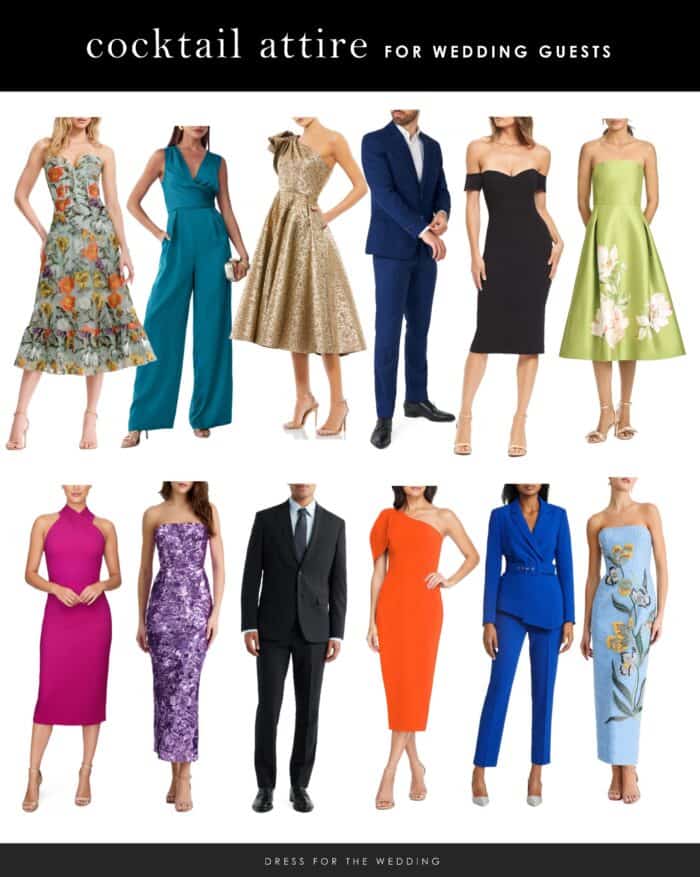
Image credits and shopping sources: Top Row: 1. Green Embroidered Strapless Dress 2. Teal Jumpsuit 3. Gold One Shoulder Dress 4. Dark Blue Suit 5. Black Off-the-Shoulder Midi 6. Green Strapless Midi Bottom Row: 1. Magenta Halter Midi 2. Purple Sequin Strapless Midi 3. Slim Fit Wool Sport Coat 4. Orange One Shoulder Midi 5. Royal Blue Suit 6. Light Blue Strapless Sequin Midi
As always, we like to start off with our signature visual guide of this dress code, along with shopping recommendations. But if you're still not sure what to wear, or you're looking to understand this dress code better, read below for our full take on why cocktail dress codes are misunderstood and why we don't necessarily recommend calling your dress code "cocktail attire" on your wedding invitation, unless you want guests to dress in a very specific way!
What Seems to Be The Modern Definition of Cocktail Attire?

A cocktail dress code can overlap with both semi-formal and formal in many ways, but in terms of true dress code etiquette, cocktail attire is meant to have its own distinctive look that doesn't include long dresses.
However, these wedding attire rules are ever-changing and taking on broader meanings, so that events with a cocktail dress code now generally signal any festive, semi-formal style. While not technically correct, it seems that, in its contemporary usage, cocktail attire often extends to include longer maxi dresses but stops short of the sweeping floor-length gowns in formal fabrics required for black-tie or white-tie events.
That said, a cocktail-attire dress code remains challenging because many guests, particularly those who lived through decades when cocktail attire meant only a specific style of shorter dresses, may still interpret it that way and feel limited to that style. We saw this on social media recently: a guest worried about being out of place in a maxi dress that was perfectly suited to the requested dress code, and the post received thousands of comments offering conflicting advice.
Younger generations might interpret cocktail attire as anything from thebody-con mini dress they wore to a homecoming dance in high school to the long, fitted gown they spotted on social media or on a shopping site with "cocktail" in the name.
In short, everyone is confused because what is sometimes referred to as cocktail attire is more accurately described as semi-formal attire, or even formal attire. Since these terms already perfectly capture the essence of these dress codes, they should be used in most cases.
What matters is what the couple or dress code really intends to ask for, which is why being more precise with dress code terms, providing clear examples, or gently offering examples on the wedding website or in the inspiration section may be necessary.
Why Is the Cocktail Attire Dress Code So Confusing?
There has been a lot of talk and confusion lately about what constitutes cocktail attire, especially when it comes to dresses. Both on social media and in retail settings, longer styles such as maxi dresses have started to be labeled as cocktail dresses, which wasn't always the case. Cocktail dresses in retail stores also include short, tight mini dresses and party dresses, so the cocktail attire dress code can inherently spark very different ideas of which style is correct, with drastically different hemlines.
From what we've seen on wedding websites and invitations, many couples are now using specific dress code terms that have always had well-defined meanings, like cocktail attire, to describe the overall feel of the event without fully understanding how these terms relate to specific clothing styles and silhouettes. This creates confusion for those who were raised on the original definitions of the dress code from etiquette experts, as well as those who are picking up modern dress-code cues on social media.
Just as language evolves, the once hard-and-fast rules that etiquette experts have dispensed for decades seem to have shifted, but that shift is creating a lot of confusion -- even for us -- making guides like this one a necessity.
Since wedding guests usually span many generations, it seems everyone has their own interpretation (and misinterpretation) of dress codes, no matter what the invitation says. But definitions and nomenclature aside, what's important is clearly understanding what your expected attire is for your specific event and what version of dress code your hosts meant by "cocktail attire."
Is a Maxi Dress Cocktail Attire?
While we think a long, flowy maxi dress in a dressy style and fabric is almost always appropriate as wedding-guest attire for a variety of dress codes, it technically isn't a cocktail dress.
So if you've received a wedding invite specifying cocktail attire, you might reasonably assume that only a short dress will do. This isn't always the case now.
In our opinion, maxi dresses are usually fine to include in cocktail attire, especially for weddings. Most wedding-guest-style maxi dresses are chameleons that can fit into so many dress codes, so this style is still fine for cocktail attire, as long as the wearer understands it is not one of the classic cocktail dresses that are usually the hallmark of the cocktail attire style.
What is the Difference Between Cocktail and Semi-Formal Attire?
Cocktail attire is typically glamorous evening-only wear that is fitted and a little bit showy, with sleek dresses, rich fabrics, and embellishment. A cocktail dress code is a semi-formal style that leans more toward the formal end of the dress code spectrum, because it is an evening look that is flashier than regular semi-formal attire. But it's a bit of a dichotomy: it's less formal in some ways because it's shorter and meant to stand out, so it isn't universally appropriate in all wedding settings. It's more formal in that the right kind of cocktail dress, with a below-the-knee style and rich fabrics, can be included in formal attire dress codes for evening wear.
For a classic dress code, the recommended cocktail attire focuses on classic, knee-length to mid-length dresses. It's a party look that might work for a wedding reception but could be out of place at some religious wedding ceremonies or might be too flashy in a truly formal setting, where elegant refinement is the look you want to aim for.
On the other hand, semi-formal dress codes are a day-to-night style that can include everything from day dresses like a breezy chiffon midi dress to an evening-appropriate fitted black mid-length cocktail dress to a longer floaty maxi dress in an elegant and romantic style. Most weddings start in the daytime and continue into the evening, making them semi-formal events. While semi-formal is a broad term, it is slightly more inclusive of various personal styles and longer dresses than cocktail attire.
For suit-wearers attending a semi-formal or cocktail-attire event, a tailored suit in a dark shade or classic black, paired with a white dress shirt, is always a polished choice.
What Is a Cocktail Dress?
By its older but still widely recognized definition, a cocktail dress is a short, festive, semi-formal dress in a special-occasion fabric such as satin, silk, or jacquard that falls between the mid-thigh and above-the-ankle.
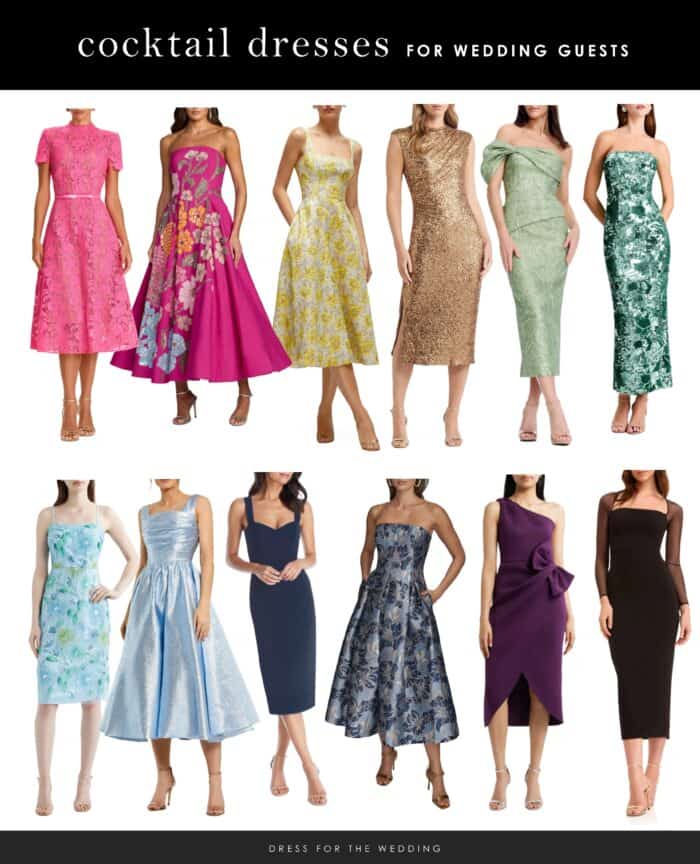
Image credit and shopping sources: 1. Pink Lace Short Sleeve Dress 2. Strapless Pink Tea Length Dress with Floral Detail Dress 3. Golden Metallic Floral Midi 4. Gold Midi Dress 5. Sage Green One Shoulder Metallic Midi 6. Green Sequin Pencil Midi Dress Bottom Row: 1. Light Blue Sequin Floral Midi 2. Light Blue A Line Party Dress 3. Navy Blue Fitted Cocktail Dress 4. Blue Strapless Jacquard Midi Dress 5. Bow Shoulder Cocktail Dress 6. Black Illusion Sleeve Midi
This encompasses hemlines that are mini, just-above-the-knee, just-below-the-knee, calf-length midi, high-low, and some tea-length (above-the-ankle) silhouettes. While most of these dresses are great choices for wedding guests, as we'll mention in depth later, many mini cocktail dresses - especially the body-con style - are usually not ideal wedding attire, with a few exceptions.
Embellishment, flourish, and a certain level of polish are expected, and formal fabrics like silk, satin, sequins, and beading are very much part of the cocktail party attire style. Usually, the dress has a bit of structure due to the heavier fabric, although some slip-style dresses have now been grouped in with cocktail style.
The classic silhouette is a fitted sheath, often in a strapless or off-the-shoulder style, though fit-and-flare, any configuration of straps or sleeves, and other short silhouettes are also definitely part of the cocktail dress style.
For those who don't wear dresses or simply want other options, a cocktail outfit can include jumpsuits or chic matching suit styles in rich, festive colors. Fitted skirts and tops, or dressy pants and festive tops - like your best going-out top - can be another perfectly acceptable look.
What about long formal dresses that are almost part of black-tie? Historically, they weren't really cocktail attire, but, again, they're increasingly assumed to be part of the dress code.
There is a specific type of strapless, longer dress, or a spaghetti strap, fitted long dress with daring details and cutouts that also seems to be catching on as cocktail attire, but it's really not specifically called for in this dress code.
There's also an elegant, relaxed maxi dress with a bit of floaty, loose caftan-style that evokes a resort look and works well with cocktail attire. It's not true cocktail attire, but the terms are changing!
When to Use Semi-Formal Instead of Cocktail as a Wedding Dress Code
As we've seen in social media discussions, many guests are genuinely confused by the designation "cocktail attire" because of its long-standing association with cocktail dresses. For couples who want their guests to wear something that reads as elevated and festive, but not over-the-top or restrictive, we feel semi-formal is a far better, all-encompassing wedding dress code. It's fancier than a casual dress code, but not as reserved as a formal one.
A semi-formal dress code has other benefits as well, since it includes all tasteful cocktail silhouettes (short knee-length dresses, midi dresses, suits, jumpsuits, and appropriate maxi dresses) while naturally ruling out very tight-fitting mini dresses and racy, slinky styles that don't suit an elegant wedding setting.
Semi-formal is also more appropriate as the designated dress code for a wider range of event time frames. Since many weddings begin in the mid-afternoon, around 3 pm, and continue into the evening, semi-formal attire is the more appropriate term, encompassing both dressy afternoon and early evening styles, while the cocktail dress code is only meant for events that start after 5 pm.
If any portion of your ceremony is held in a house of worship, a semi-formal dress code conveys the reverence that setting requires while still allowing for a celebratory, party-like reception atmosphere. It is a cleaner, more guest-friendly way to communicate a dress code that falls between smart casual and formal, and is a few steps away from black tie. The style should be festive, but not overly flashy.
That said, if you don't start the wedding until after 5, and you want your guests to wear little black dresses, or their most glamorous styles, and you want to open it up to mini party dresses as well as longer, showy, more revealing looks, then a cocktail or even a formal cocktail dress code might be a good way to describe it! A wedding held in a modern location like an art museum, an intimate reception at a restaurant, or a modern city loft wedding might be the perfect place to ask for cocktail attire. Just be sure to give examples of what your dress code is, and isn't.
Are Mini Cocktail Dresses Appropriate for Wedding Guests?
While talking about cocktail dresses, we also have to address this, and we'll do it in long form in another post. Is a mini dress appropriate for a wedding? Broadly speaking, a very short cocktail mini dress is not the most appropriate outfit for a wedding, especially if you're unsure of the dress code. Only a small fraction of mini dresses shown by retailers each season would make for good wedding attire.
That said, there are some gorgeous mini dresses that make great wedding guest dresses for certain events, but they have distinctive features we'll discuss in more detail in another article. Elegant minis designed by brands such as Mac Duggal and Adrianna Papell feature a little more coverage and looser silhouettes, making them much more wedding-friendly.
There is also a newer style of mini-meets-maxi in which a sheer chiffon overlay or a fringe silhouette extends to the floor over a fitted mini underlayer; these read as formal enough and generally work well.
Why Shouldn't You Wear a Super Short Wedding Guest Dress?
In short (haha!), a mini shouldn't be your first choice of dress for most weddings. Even though you'd think the cooler, shorter silhouette would perfectly suit summer weddings, a super short style can awkwardly stand out as the wrong choice in a sea of midis and maxis, and it can be difficult to move, dance, hug, and sit without accidentally showing too much.
It's only appropriate if you know this is the guest style that your friend group wears, or if the couple truly wants people to turn up in this sort of party-style dress, even though the confirmed dress code is cocktail attire.
Even then, tight-fitted minis should be saved for bachelorette parties and other fun nights out. If you're a plus-one or a guest who really doesn't know the couple, it's still best to stick to a hemline that reaches the knee, or midi and maxi dress territory, to be safe.
Cocktail Dresses for Other Events
If you've arrived here looking for cocktail party outfit ideas beyond weddings, we have those covered, too. Cocktail attire is a perfect opportunity to show personal style at cocktail hour charity events, fancy cocktail parties, and holiday parties. Cocktail attire works beautifully for all of these; it is, after all, the type of event these dresses were always meant for.
For dresses that work for charity events, semi-formal birthday parties, bachelorette parties, and semi-formal school events like homecoming and sorority semi-formals, take a look at the short dresses and mini styles in our LTK shop. The women's cocktail attire section is organized by body type and personal style so you can find what works for your silhouette. Whatever the occasion, the right cocktail outfit is out there, reflective of your personal style, dressy without being overdressed, and ready for the next soiree.
Whether you're dressing for an evening event, a cocktail party, or a formal but festive celebration, these are the options that we think will serve you well!
Wedding Attire Ideas for a Cocktail Dress Code
While we're showing more true cocktail dresses in this shopping section, as we mentioned, we generally think couples intend to include maxi dresses and longer semi-formal attire when they ask for a cocktail attire dress code, which is slightly at odds with what a true cocktail dress code suggests. We've included some modernized versions of the cocktail look here, with a few longer dresses, but we also have a separate page for semi-formal attire that showcases even more midi and maxi dress styles and fewer fitted, flashy true cocktail styles.
More Wedding Guest Dress Ideas
If you've realized your cocktail attire wedding really meant semi-formal, check out our picks for semi-formal wedding guest dresses. If you're still a bit confused, but think a maxi dress might be the perfect style for a daytime ceremony and evening reception, then check out these maxi dresses for wedding guests.
We have wedding guest dresses organized by color as well, or check out these picks by season for summer wedding guest dresses and fall wedding guest dresses.
Discover more from Dress for the Wedding
Subscribe to get the latest posts sent to your email.